かぎりなき夏 Endless Summer: A Review, A Reckoning
Note: The following is personal opinion, experience, and reflection. The film is Endless Summer / かぎりなき夏, a Japanese City Pop documentary. I recommend it unreservedly for those who want to learn the true history of the genre.
There is a Hideki Saijo cover song from 1984 called かぎりなき夏 , Endless Summer. The lyrics, if you can even call them that in any conventional sense, don't mention love at all. They don't describe any relationship. It's just a man on an empty beach, a sea breeze, the hazy light of a season that refuses to conclude, and an ache that has no name. A Japanese music writer once told me the song is less a pop song and more a scene from a European film that nobody made. I've thought about that description many times over the years, usually at dusk, usually alone, usually with something warm in a cup going cold on the table beside me. When I heard that a City Pop documentary had taken its name from that song, I felt something shift in my chest, that particular movement that happens when you realize something out in the world has understood what you were trying to say all along, even though you never quite said it yourself.
I watched Endless Summer the way I watch most things that matter to me, which is to say badly, pausing it, rewinding, getting up to pace around, standing in the kitchen with the lights off, then coming back and pressing play again. Not because it is difficult viewing. It isn't. It is extraordinarily beautiful, actually patient and lyrical and assembled with genuine love for the music and source material. I watched it in such a way because it kept hitting nerves I forgot I had. So many times I had been burnt by Japan, betrayed by City Pop artists, and denied some of the only connections I had ever really felt. I watched with a pendulum heart, swinging between joy and melancholy. I hesitate to watch or read anything related to City Pop because too often I’m written out of the story. Even Anri, who clearly knew it was me who helped get her music heard by millions of people online way before the boom, wrote me completely out of the story in her latest interview even though I had met her in 2019, been featured on her CNN video, and written articles about her that are quoted on her Wikipedia. But I digress, we all pay for our transgressions in one way or another.
I think City Pop’s story has been re-hashed and re-interpreted too many times already by people who didn’t even live in Japan at the time, or even know about City Pop before the boom. This is why it’s unfortunate when someone who has power to spread information in major publications does so without fully understanding what they are saying, which often results in history being re-written. Some Japanese people who lived during the era say it was nothing like the music describes, others recall it more closely like the lyrics. But what it lingers on, what gives it its particular weight, is the strangeness of how this music was rediscovered, not by Japan, but by the world outside Japan, and then returned to Japan like a package addressed incorrectly that somehow finds its way home. The documentary understands something that took me years of living inside this story to see clearly: City Pop was forgotten in its own country, and it took outsiders with no cultural baggage, no embarrassment, no outdated associations, no memory of how uncool it was considered by 1995 to hear it purely, to hear it for what it actually was.
I didn't get into City Pop to be acknowledged. I got into it because hearing Matsubara’s voice on a vinyl record at two in the morning for the first felt like being handed a map to somewhere I had been trying to get to my whole life.
The film conveys the Fenollosa dimension of this story. The 19th century American scholar who traveled to Meiji Japan and helped Japanese people see their own art as a treasure worth preserving, even as he was instrumental in some of it leaving the country has become something of a guiding metaphor for my own role in the City Pop revival. Ryusei Miyakodori, editor-in-chief at Mag2news, in his research and writing, has called me the modern Fenollosa more than once. I find the comparison both moving and quietly devastating. Fenollosa is not particularly famous. His name is known mainly to specialists. The art he rescued, the culture he loved and championed, outlasted him by a century and a half. He is the figure who the frame crops out.
There is a moment in the documentary when someone describes the City Pop boom arriving in Japan from overseas, and someone else says something that hit me like cold water: that only the boom arrived not the story behind it. Not the people who built the runway before the plane took off. The film is thoughtful enough to sit with that discomfort rather than wave it away. It understands that the genre's second life is inseparable from a set of mostly anonymous digital evangelists, crate-diggers, DJs, bloggers, obsessives who were doing the work before it was rewarded, before it was cool ‘again, before any of the major labels started pressing vinyl represses and calling it a cultural moment. Japan’s corporate machinations have little respect or appreciation for such individuals, and if karma exists, it is sure to bring justice eventually to this situation.
I didn't get into City Pop to be acknowledged. Any fame acquired was accidental. I got into it because hearing Matsubara’s voice on a vinyl record at two in the morning felt like being handed a map to somewhere I had been trying to get to my whole life. The music is about a Japan that was reaching for something, a version of cosmopolitan ease, a breezy fantasy of West Coast summers, yacht parties, the warm particular blue of a Pacific that existed mostly in the imagination. It was aspirational in the way that all great pop music is aspirational: it describes not where you are but where you wish you could be, and in the description, the longing itself becomes a kind of beauty. That quality, the longing dressed up as ease, melancholy wearing the costume of a summer evening, is what I recognized in it immediately, and what I have been trying to explain to people ever since.
City Pop was Japan dreaming of the West. And then the West woke up inside the dream, and found it beautiful, and started dreaming back.
City Pop was Japan dreaming of the West. And then the West woke up inside the dream, and found it beautiful, and started dreaming back. The documentary understands this loop. It doesn't flatten it into a simple story of rediscovery; it honors the strangeness of it, the way cultural exchange at its strangest is also cultural exchange at its most productive. I think of Haruomi Hosono's exotica trilogy: Tropical Dandy, Bon Voyage Co., Paraiso, in which Hosono essentially made music about a tropicalia that didn't exist, that was always a fever dream conjured from old Hollywood films and childhood fantasies. And now that music is beloved around the world, by people who project their own fantasies onto his. The dreams stack up. They don't cancel each other out.
I have to speak about the forgotten legend, Yoichi Takizawa, because the film's title belongs to him, and because his story and mine are tangled in a way that still seems, on certain evenings, less like biography and more like something arranged by a force that doesn't have a name. So much of City Pop deals with memory, things being forgotten, re-discovery, and naiviety. I think these things are inescapable when looking at the music, it’s downfall, revival, all of it.
Takizawa was a singer-songwriter and composer who, in the late 1970s, led a band called Magical City. In 1982 he recorded a second ‘phantom’ album, BOY, a work of fully realized City Pop craftsmanship, layered, sophisticated, luminous. The album was shelved before release. The music industry made a calculation, the way it always does, and the calculation did not favor the album. Takizawa, rather than let one of his songs vanish entirely, brought it to a contact at RCA, who arranged for Hideki Saijo to record it. That song was かぎりなき夏. Saijo released it in 1984. The album BOY remained locked away in boxes, unreleased, for forty-two years.
Takizawa died in 2006 at the age of 56. He never saw his album released. He never knew that a DJ in Chicago would one day hear かぎりなき夏 on Hideki Saijo's record and build a webpage about it, a special dedicated page, because the song demanded that kind of attention and that this would become a thread that would eventually help to pull his phantom album back into the world by Miyakodori.
I released a remix of Yoichi Takizawa's Endless Summer in 2024, thanks to the hard work of Miyakodori. When I made the remix I wasn't thinking about Tatsuro, Anri, or any other city pop artist’s style. I was thinking about the way the melody sits in the chest after it ends, the way it doesn't quite resolve, the way it leaves you slightly outside of time. That feeling, the song that ends but doesn't quite finish, is what only legendary music does to me still, after a life-time inside it, after everything. The title of this documentary is named for a song about a summer that refuses to end even as it's clearly ending, and I think that is as honest a metaphor for this whole strange chapter of my life as anything I could construct myself. When I left Miami Beach, I could not bear the Summer any longer, it was truly endless, and in that sweat, that boiling sun, I felt the need to leave and feel some kind of ending.
It feels like I grew up in that Magical City that Takizawa was dreaming of.
I was born in Miami Beach, Florida. There is a nickname for Miami that locals use with the easy pride of people who have never had to justify why they live somewhere beautiful: the Magic City. I grew up there, in the particular humid light of South Florida, surrounded by a culture I felt adjacent to but never quite of, and I carried the city's name with me when I left. I did not know, at the time, that I was carrying it toward something. I did not know that the thing I was moving toward had its own name, a name so close to the one I'd been born into that when I finally learned it, years later, sitting in front of a research document in Chicago, I had to read the sentence twice. The backing band of the Japanese composer who wrote the song that became the hinge of my life was called Magical City. It feels like grew up in that Magical City that Takizawa was dreaming of.
When Miyakodori, in his years of research into Takizawa's life and music, discovered that I had encountered this song and devoted a page of my site to it, he reached out. We began a correspondence that lasted years. And when, through a series of events that belong more to the logic of myth than to the logic of the music industry, the multitrack masters of BOY were found to be too deteriorated to use all except one tape, one track, the one that had somehow survived, that track was かぎりなき夏. The song that had begun as a song rescued from a shelved album. The song given to Saijo. The song that reached me in Chicago. The song that connected me to Miyakodori. The song that was now, miraculously, still playable on a reel-to-reel tape found in boxes that had been through multiple house moves, aging quietly in a corner, waiting.
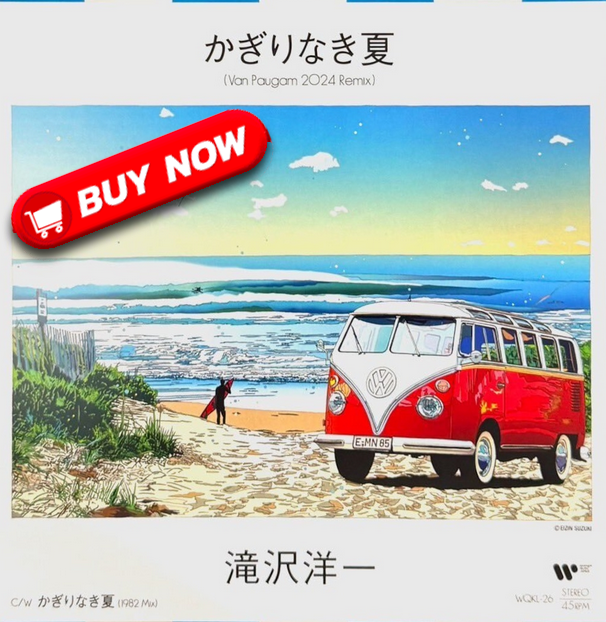
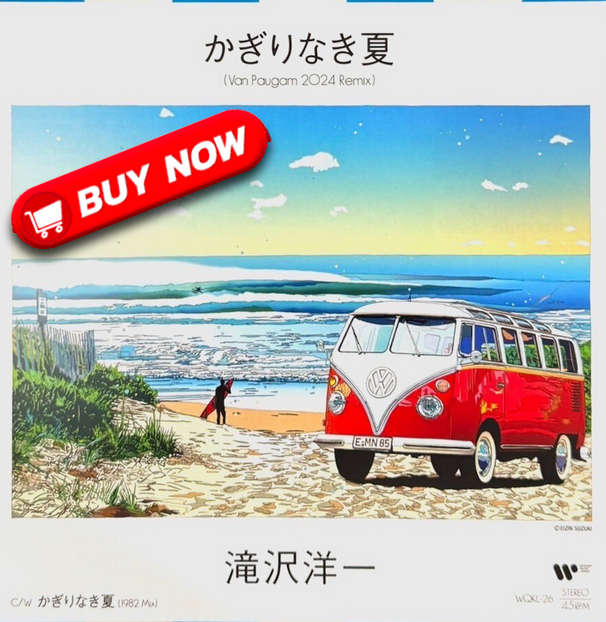
When Miyakodori sent me the multitrack. I worked on it for a long time, in the way that you work on things that feel like more than work; carefully, with something close to reverence, trying to honor a recording made in 1982 by a man I never met, for an album that was never heard, for a city I grew up in whose name was a shadow of his band's name. The remix was released on Christmas Day, 2024, the A-side of an analog single on Warner Music Japan, with Eizin Suzuki's artwork on the cover. Endless Summer. A painting of a Van on a beach by the man who made the visual world of City Pop, covering a song by the man who helped develop its sonic world, remixed by me, who carried it to a global audience that didn't yet have a name for what it was hearing. And then, a few months later, BOY came out. Forty-two years after it was shelved. The phantom album, whole at last, released into the world.
The B-side is the 1982 original mix, found on the one surviving tape, including wave sound effects that no subsequent mix could reproduce, because those sounds hadn't been preserved on the multitrack. The ocean sounds from 1982, miraculously intact. You can hear the waves. You can hear what Takizawa heard when he made the record that was never released. The sea that runs beneath everything. かぎりなき夏. The endless summer that waited forty-two years to become audible.
You would think an innocuous genre of music would be free of controversy, but there is still much to be discovered about how it became popular again, and the future that is bound to repeat the past if not corrected. Watch this documentary. Watch it for the music, and the visuals, and the intelligent and tender way it traces a cultural phenomenon that changed what the world thinks it knows about Japanese pop. And if you find yourself moved, if you find yourself sitting in the particular silence that a good film about music leaves in its wake, know that behind the documentary is a deeper story, still being written. A phantom album, finally released. A tape that somehow survived.
I want to thank Ryusei Miyakodori, Yoichi Takizawa’s wife, and everyone who had a hand in allowing this beautiful story to unfold. The man on the empty beach is not me, and it is not any particular person likely. But I feel like I know him. The sea breeze moves through the room. The record turns, and my tea always gets cold, but the summer that won't quite end continues its beautiful, unhurried refusal. - Van Paugam